

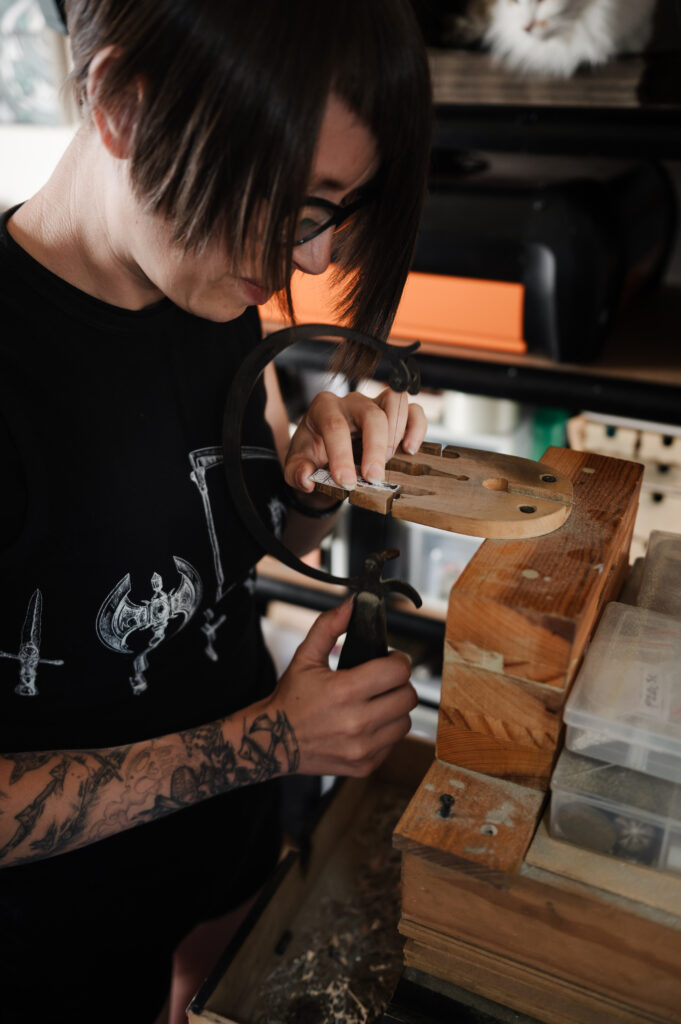
Should you try saw piercing?
So you’re thinking about taking up jewellery making for fun or professionally? Maybe you’re already a jeweller but you only use your saw occasionally to cut thick wire? Perhaps you’ve already tried saw piercing but got frustrated and gave up?
Wondering if you should apply the time and practice required to get good at saw piercing? I’ve been doing it almost daily for over 15 years so hopefully I can put all your questions to rest.
It’s very important that I begin with this statement: Saw piercing is not for everyone!
Like any creative process some people will appreciate it more than others. The good news is that the ones who can get to the point of enjoying saw piercing will ultimately excel at it, because they will be the ones who put the time in. You see, unlike many creative endeavours, natural talent is less important than practice.
I started saw piercing because I saw it as a great avenue to achieve fine detail and I enjoyed the process almost immediately. Because I enjoyed it I used that technique more than any other so I got good at it quickly. It’s as simple as that. People marvel at my skills and ask if my work is laser cut but it fundamentally comes down to the time I’ve put in. Theoretically, anyone could do it.
Who’s it good for?
Saw piercing is best suited to people who find relaxation in mindless repetitive tasks. If the idea of stamping 500 pieces of paper, doing a puzzle or tackling a colouring in book makes you warm and fuzzy inside, it may well be worth a try. If however your brain needs constant novel stimulation, saw piercing may have the opposite effect. Rather than meditation, you will probably experience frustration.
What are the benefits of saw piercing?
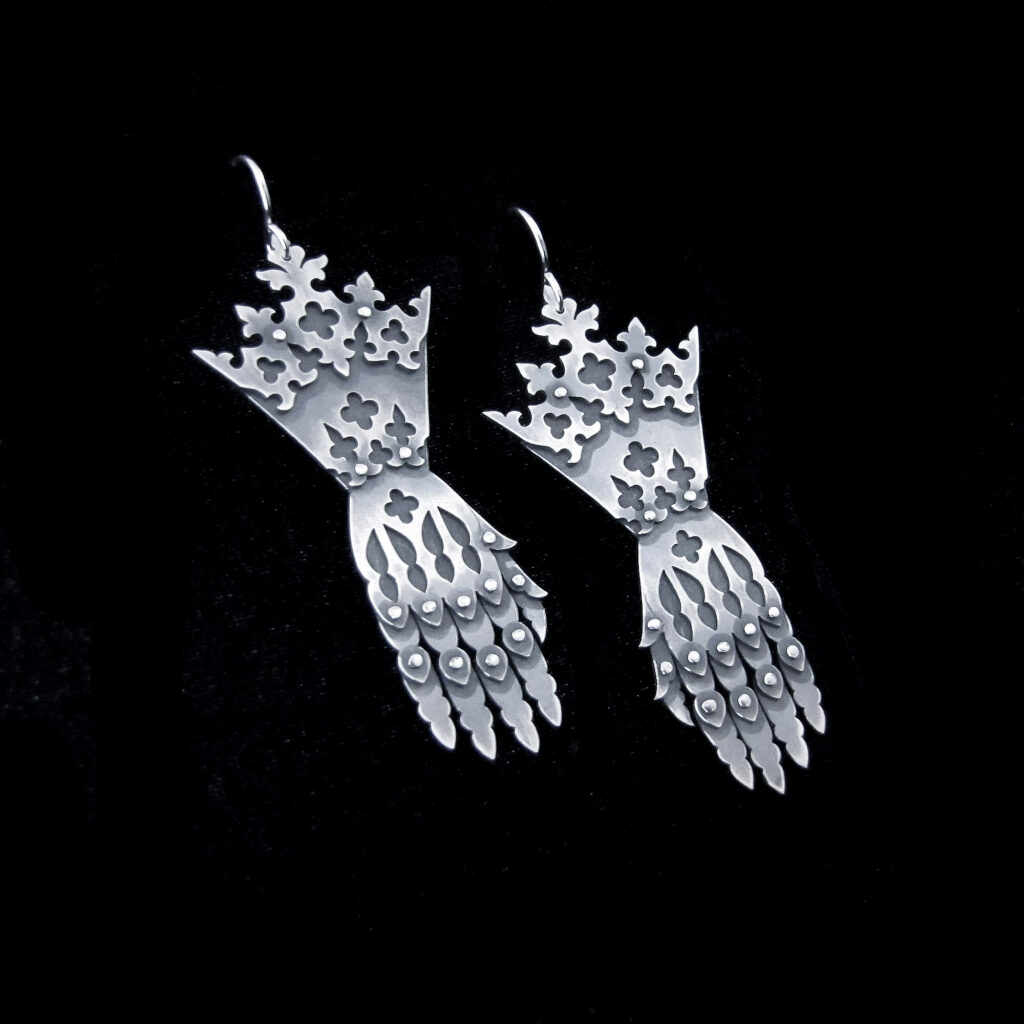
So what can hand sawing achieve for you that other techniques might not? Detail is at the top of the list. But more than that, it’s consistent, controlled detail. For example, you could achieve the same detail from engraving but that requires a steady hand at just the right angle and a decent amount of skill. When you’re saw piercing, your blade is a consistent width and you’re just following a line. Your hand is in constant motion so steadiness is not required. There is a much smaller chance of error but if you do make one it can be filed away.
Unlike with casting, saw piercing is low cost with immediate results and requires only one or two tools. So if you don’t have a fully equipped studio but rather a desk in your bedroom, you could still produce jewellery. It’s the ideal beginner’s technique because there is virtually no barrier to entry. You also don’t have to rely on an outside service to get your pieces finished.
What are the drawbacks of saw piercing?
There are of course some negatives, most of which can be mitigated. Working with small detail for long periods can cause eye strain and headaches. I wear glasses while I’m working so this is no longer a problem. Back and neck pain are also a common issue. To combat this I generally saw standing up and maintain good posture through yoga.
The design limitation is of course the 2D nature of cutting from flat sheet. You can achieve some dimension through layering but if you want 3D sculpture, saw piercing is not the most efficient method.
Be prepared for dust! While you don’t need a fancy filtration system, it is wise to have something under your bench peg to catch the larger pieces of metal and be prepared to vacuum around your work area regularly because metal dust will settle on everything.
Now you have all the information hopefully you can make an informed decision about whether saw piercing is the right technique for you. If you just want to test the waters I’ve written a blog post about how to get started or you can purchase my video tutorial where you can actually see the process. I also occasionally host in person workshops so check out my workshop page to see if there’s one coming up near you.
Happy sawing! Or not, as the case may be…